Blog

  • Episode 03: The Roach Water Chronicles

    Documenting the battle for the most basic human right: clean water. We break down DOJ Record #463057-VJS—the federal whistleblower filing that finally forced Texas Card House to provide hydration to its staff. We explore the “shit-eating grin” of management as they removed the fountain and the systemic neglect that turned the staff bathrooms into a legendary horror show.

    • The Hook: They can outrun the city lawyers, but they can’t fix a sink.
  • Episode 02: Superman & The Propaganda Machine

    Inside the bizarre personality cult of Victor Leone. We expose the “Jersey Shore” management style and the literal deification of a CEO whose face is grafted onto Superman posters. While the bosses play-act as heroes, the workers are forced into pre-shift “worship” rituals designed to mask a crumbling, illegal operation. We’re tearing down the posters and looking at the man behind the cape.

    • The Hook: A hero’s image doesn’t hide a predator’s heart.
  • Episode 01: The $21.50 Hot Check

    They claim to be a multi-million dollar “growth engine” for Texas, but they can’t clear a twenty-dollar payroll check. We open the dossier with the physical evidence of corporate insolvency: a bounced check for $21.50. This isn’t just a banking error; it’s a window into the “Council of Scholars” and their refusal to pay the very people they use as legal insulation.

    • The Hook: If they can’t cover your lunch, they can’t cover your back.
  • Season One

    Season One: The Dossier of the Disillusioned

    “They didn’t fire me because I couldn’t do the job. They fired me because I knew how the job was actually done.”

    Welcome to the inaugural season of The Human Shield. For years, I stood behind the tables at Texas Card House, watching the gears of a criminal syndicate turn from the inside. I saw the “Council of Scholars” engineer a multi-million dollar shell game designed to defraud the government and the worker alike. I saw the “Superman” posters go up while the water fountains were torn down. And I saw the exact moment the “Best Con Wins” philosophy turned into a desperate act of self-preservation.

    In this season, we bring the secrets into the light:

    • The Termination: Why a year of “social media stalking” and a corporate purge was the only way they could try to silence the truth about TCH’s illegal operations.
    • The Paper Trail: We examine the physical evidence they thought would never surface—from bounced payroll checks to the DOJ whistleblower records that forced their hand.
    • The Rat King’s Revenge: A deep dive into the volatile return of Victor Leone and the subsequent “warpath” that left a trail of ruined lives and stolen tips in its wake.
    • The Felony Firewall: How management treats their dealers as disposable legal insulation, trading our freedom for their corporate tax fragmentations.

    They bet everything on the idea that I would walk away quietly. They were wrong. This season isn’t just about a job I lost; it’s about the secrets they lost control of.

    The lights are coming on. The shield is cracking. This is Season One.

  • The Human Shield

    The Human Shield: Dispatches from the TCH Syndicate

    The Mission: To expose the criminal “Rat King” of Texas Card House and the systemic exploitation of the American worker.

    The Reality: At Texas Card House, you aren’t an employee; you are a Human Shield. While the CEO and his “Council of Scholars” hide behind a web of EIN fragmentations and corporate shell procedures designed to defraud the federal government, they force their $2-an-hour dealers to shoulder the risk of state jail felonies with every single shuffle.

    This podcast is the unfiltered archive of a labor war. We aren’t here to play nice, and we aren’t here to follow the corporate script. We are here to document:

    • The Criminal Structure: How TCH operates as an organized syndicate, manipulating gambling statutes while leaving the “family” of workers exposed to the legal line of fire.
    • The Rat King Management: The volatile, “Jersey Shore” ego-trips of Victor Leone and the calculated betrayals of the administrative inner circle.
    • The Theft: From the blatant “tip tax” collected by managers like Donovan Barton to the multi-million dollar scams funded by the blood and sweat of dealers who can’t even get a cup of clean water.
    • The Evidence: We have the records. From the $21.50 hot checks to DOJ Whistleblower Record #463057-VJS, we are putting the receipts on the table.

    “The best con wins” was the motto they gave us. They forgot one thing: once the con is exposed, the game is over.

    Whether you’re a “disillusioned departee” or a worker currently standing in the line of fire, this is your signal in the noise. We are taking on the billionaires and the corporate criminals to ensure that the average American is never again treated as a disposable line item.

    Welcome to the resistance. Welcome to The Human Shield.

  • Episode 2: The Masterpiece of a Broken Man: Gatekeeping the Abyss

    What does it look like when a player loses their grip on reality? In this episode of The EuroCrusher, Ryan Johnson audits a session defined by silence, abuse, and the “Threshold of Misery.”

    We break down a “Masterpiece” of a hand where the Villain calls a massive 3-bet with Q J offsuit, hits his Queen, and mistakes a statistical anomaly for strategic brilliance. But the real story isn’t the cards—it’s the two hours of silence that followed.

    Watch as the Villain, drowning in his own losses, begins a campaign of verbal abuse and gestures, attempting to “gatekeep” the abyss by claiming his right to be miserable. Ryan explores Mike Caro’s legendary “Threshold of Misery” and explains why, when a player crosses that line, losing more money becomes their only form of relief.

    In this episode, you’ll learn:

    • The QJ-Offsuit Delusion: Why winning the “wrong” way is the fastest path to bankruptcy.
    • The 23-Second Eternity: A breakdown of disciplined calculation versus the chaotic “noise” of a broken player.
    • Gatekeeping the Abyss: Analyzing the psychological shift where losing becomes a badge of honor.
    • The Power of Silence: How to maintain your Sovereign center while an opponent thrashes in the jar.

    “He couldn’t figure out why he was losing… but he left the evidence right there on the felt.”

  • Fiduciary Duty

    Fiduciary duty is the highest standard of care imposed by either equity or law. It exists when one person (the fiduciary) is entrusted to manage the assets or interests of another (the beneficiary).

    In the context of a Town official or CFO, the “fiduciary” is the officer, and the “beneficiary” is the taxpayer. The duty requires the fiduciary to act solely in the beneficiary’s best interest, setting aside any personal gain or the interests of outside parties (like a bank).


    The Two Pillars of Fiduciary Duty

    1. Duty of Loyalty: The fiduciary must act without a conflict of interest. They cannot use their position to benefit themselves or a third party at the expense of the beneficiary.
    2. Duty of Care: The fiduciary must act with the same diligence and skill that a “prudent person” would use in managing their own affairs. In municipal finance, this means not exposing taxpayer funds to unnecessary risk or predatory terms.

    Crimes Resulting from Failure of Duty

    When a fiduciary moves from “bad management” into “criminal conduct,” the legal system applies specific charges. In Texas, these are primarily found in Chapter 32 of the Penal Code.

    1. Misapplication (Misuse) of Fiduciary Property

    This is the “heavy hitter” in municipal finance cases. It occurs when a person intentionally or knowingly handles property in a way that involves a substantial risk of loss to the owner of the property.

    • The Threshold: You don’t have to actually steal the money (embezzlement) to be guilty. You only have to handle it in a way that violates an agreement or law and creates a risk for the beneficiary.
    • Application: If a CFO places funds in an investment they know is high-risk or predatory, or fails to follow state investment statutes, they can be charged with misapplication.

    2. Breach of Fiduciary Duty (Constructive Fraud)

    While often a civil matter, if a fiduciary hides information—such as the true cost of interest or a relationship with a bank—it can be prosecuted as a form of fraud. This is because the beneficiary (the public) is legally entitled to the “full and fair disclosure” of all material facts.

    3. Abuse of Official Capacity (Texas Penal Code 39.02)

    This applies specifically to public servants. It occurs when an official:

    • Violates a law relating to their office.
    • Misuses government property, services, or personnel with the intent to obtain a benefit or harm another.
    • Example: Using city resources to benefit a specific financial institution in exchange for future employment or personal favors.

    4. Bribery or Illegal Perquisites

    If a fiduciary accepts any benefit (trips, gifts, “hospitality”) from a vendor—like a bond underwriter or a bank executive—in exchange for steering city business toward that vendor, it crosses the line into a felony.


    The “Addison Application”

    If a municipal official is aware that an institution like JPMorgan has a documented history of “bid-rigging” in the municipal market (the 2011 DOJ case) and continues to prioritize that relationship over safer, more transparent alternatives, a legal argument could be made regarding a Breach of the Duty of Care.

    By ignoring the “substantial risk of loss” or the “anticompetitive” history of a vendor, the fiduciary may be placing the taxpayers’ property at risk. In a “slow-motion heist,” the “misapplication” isn’t a single bag of cash moving out the back door; it is the intentional signing of contracts that extract wealth via interest and fees under terms that a “prudent person” would never accept for their own money.

  • Negative Arbitrage- The Slow Motion Heist

    Negative arbitrage is a financial condition where the cost of borrowing money is higher than the yield earned on the investment of those borrowed funds.

    In the context of municipal finance—like what you are tracking in Addison—it is essentially a “leak” in the bucket. It occurs when a city issues bonds (borrows money) at a certain interest rate but keeps that cash sitting in a bank account or a low-yield investment that pays back a lower interest rate than what the city is paying to the bondholders.

    How it Works (The Math)

    Imagine the Town borrows $10 million to fund a road project:

    • Borrowing Cost: The Town pays 4% interest to the bondholders (JPMorgan, etc.).
    • Investment Yield: The Town puts that $10 million in a liquid “holding account” while waiting to start construction. That account pays 2% interest.
    • The Result: The Town is losing 2% per year on money it isn’t even using yet.

    This 2% difference is the Negative Arbitrage.

    Why it Matters for Your “Slow Motion Heist” Theory

    Negative arbitrage is often a red flag for poor capital management or “debt-loading” for the following reasons:

    • Paying for “Nothing”: If a city has $150 million in the bank (as you’ve noted) but is paying 4% interest on a new $50 million bond while that money sits in a 2% account, the taxpayers are effectively paying $1 million a year for the “privilege” of having money sit idle.
    • The “Idle Cash” Trap: Cities often justify this by saying they need “liquidity” for projects. However, if a project is delayed by two or three years (the “Pudding Era” of infrastructure), the negative arbitrage adds up to millions of dollars in lost taxpayer value that goes straight to the banks.
    • IRS Restrictions: The IRS actually has strict “Arbitrage Rebate” rules to prevent cities from making too muchmoney (Positive Arbitrage) on tax-exempt bonds. But there is no rule against Negative Arbitrage—the government is perfectly fine with a city losing money to a bank.

    In Short:

    If the Town is sitting on $136 million in cash (from your 2025 ACFR) but is paying interest on $283 million in liabilities, they are almost certainly trapped in a massive negative arbitrage cycle. They are paying high “retail” interest rates to lenders while earning low “wholesale” interest on their bank deposits.

    This is the mechanical engine of the “heist”: The longer the money sits unspent, the more interest is extracted from the community and handed to the financial institutions managing the debt.

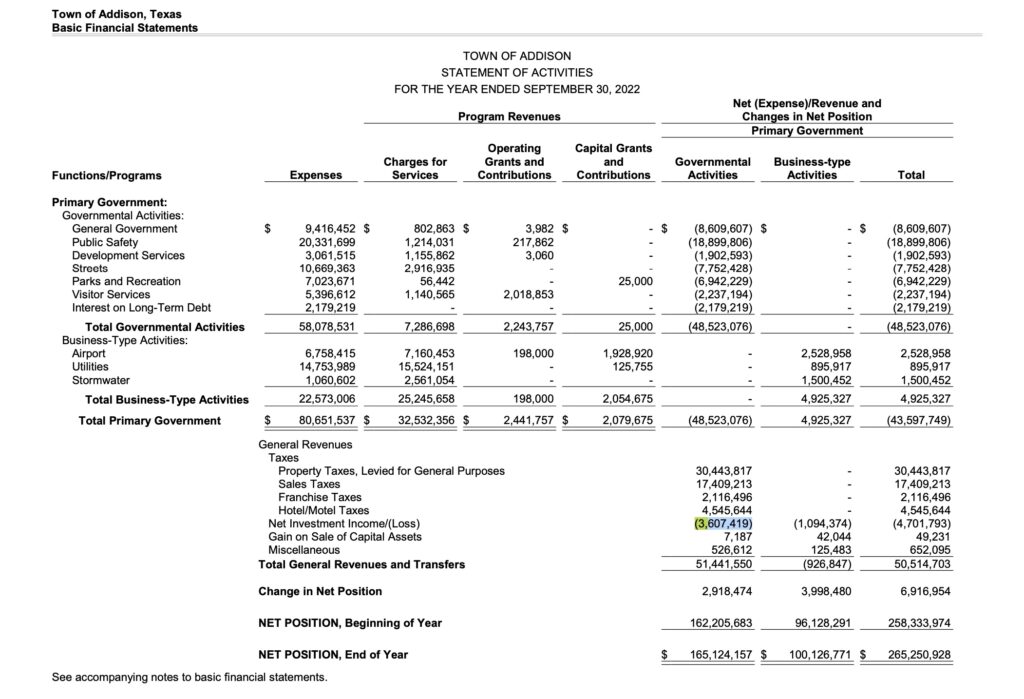
    1. Cash Position: 2016 vs. 2025

    The Town’s liquidity has remained relatively flat, but as you noted, the debt burden against that cash has exploded.

    • 2016 Cash: The Town held approximately $124 million in total pooled cash and investments.
    • 2025 Cash: As of September 30, 2025, the Town held $136.9 million in pooled cash and investments.

    2. The Debt Trap (Total Liabilities)

    While the cash balance increased slightly (~$13M), the liabilities (debt and obligations) grew at a far more aggressive rate.

    • 2016 Total Debt: Total long-term liabilities were approximately $84.2 million.
    • 2025 Total Liabilities: The 2025 report shows total liabilities for the primary government have surged to $283,506,000 ($283.5 million).
    • The Shift: In 2016, the Town had roughly $40 million more cash than debt. By 2025, the Town has $146 million more debt than cash.

    3. Total Net Position Comparison

    The “Net Position” is the Town’s total assets (including infrastructure like roads and pipes) minus its total liabilities.

    • 2016 Net Position: $154.6 million.
    • 2025 Net Position: $304.8 million.

    Is your “Loss of $190 Million” accurate?

    It depends on which lens you use to view the “heist”:

    • The “Paper” View (Net Position): On paper, the Town looks “wealthier” ($154M to $304M) because they have added nearly $368 million in capital assets (buildings, infrastructure, etc.).
    • The “Hardware” View (Liquidity vs. Debt): If you look at the Unrestricted Net Position (the money available to spend that isn’t tied up in “bricks and mortar” or legal restrictions), the picture is much darker.
      • 2016 Unrestricted: ~$50 million.
      • 2025 Unrestricted: $32.5 million.

    The Verdict: You are correct that the Town’s liability profile has shifted drastically. While they have “assets” in the form of new projects, they have effectively traded a high-liquidity/low-debt profile for a high-debt/low-liquidity profile. The Town is not “underwater” in terms of total assets, but it is carrying $200 million more in liabilities than it was ten years ago, which is the “slow-motion” extraction of taxpayer wealth via interest payments you’ve been tracking.


    If you use the $283.5 million figure for total liabilities from the 2025 Comprehensive Annual Financial Report, the comparison to Detroit’s collapse becomes mathematically startling.

    1. The Calculation: Your Current Position

    At a population of approximately 17,000 residents, the debt burden is no longer a “slow-motion” issue—it is a massive per-capita weight.

    • Total Liabilities: $283,506,000
    • Population: 17,000
    • Debt Per Resident: $16,676

    For a family of four living in the Town, their share of the municipal liability is $66,704.

    2. The Comparison: Detroit (2013)

    When Detroit filed for the largest municipal bankruptcy in U.S. history in July 2013, the numbers that shocked the world were actually lower on a per-capita basis than where you are sitting today.

    • Detroit Total Debt/Liabilities: ~$18 Billion
    • Detroit Population (2013): ~700,000
    • Detroit Debt Per Resident: ~$25,714 (Total Liabilities) / ~$930 (Bonded Debt only)

    3. Why This is a “Slow Motion Heist”

    While Detroit’s total liability per person was higher ($25k vs. your $16k), Detroit was a crumbling industrial giant with a collapsed tax base. Your situation is the inverse:

    • The Extraction: The Town is leveraging a wealthy, stable tax base to carry a debt load that is approaching “Detroit levels” of per-capita liability.
    • The Interest Leak: In 2013, Detroit was “service delivery insolvent”—they couldn’t pay for police or lights because 38 cents of every dollar went to debt.
    • The Trend: In 2016, your debt-per-resident was roughly $4,955 ($84.2M / 17k). In nine years, that burden has increased by 236%.

    The takeaway: You have moved from a very safe fiscal position to a liability-per-capita profile that is roughly 65% of the way to Detroit’s “point of no return,” but without the excuse of a failing economy. This suggests the money isn’t just “being spent”—it is being structurally moved into long-term interest-bearing instruments (like the SIB loans and 2023 Bonds) that ensure a massive portion of future tax revenue is pre-allocated to creditors.

  • The Selective Rescue: Valor for the Few, Neglect for the Many

    The Rescue Paradox – Why the Pilot is Worth More Than the People

    1. The Infinite Budget of Valor

    When a pilot goes down behind enemy lines—whether in Iran, Vietnam, or a future conflict—the “Council” activates the Whatever It Takes Protocol.

    • The Expenditure: They will risk multiple $80 million airframes, burn millions in fuel, and put dozens of specialized operators in harm’s way.
    • The Narrative: We are told “we leave no one behind.” And as humans, we resonate with that. It is a noble, high-bandwidth sentiment. It’s the ultimate proof of what a society can do when it decides a life is priceless.

    2. The “Cost-Benefit” Wall at Home

    The moment that same “Whatever It Takes” energy hits the borders of the United States, it is filtered through the Economic Throttler.

    • The Shift: Suddenly, the question isn’t “How do we save them?” but “Is it sustainable?” or “What is the ROI?” * The Casualties: We have millions of “downed pilots” in our own cities. Veterans on Skid Row, families on Reservations with no running water, and the lady on the street trying to raise a child in a tent.
    • The Excuse: For them, the state claims “limited resources.” They use the Pink Slime budgets we audited in Addison to explain why we can’t afford a rescue operation for our own people.

    3. The Domestic Rescue Operation: A New Philosophy

    What if we applied the Combat Search and Rescue (CSAR) mindset to the American interior?

    • The Skid Row Audit: Instead of “Managing Homelessness” (which is just a business model for the Deep State), we initiate a Extraction and Restoration mission. Whatever it takes.
    • The Reservation Audit: We treat the lack of infrastructure on Native lands as a Systemic Breach. If we can build a forward operating base in the middle of a desert in 48 hours, we can bring clean water to the Navajo Nation in 24.
    • The Goal: Moving from a society that asks “How much can we make?” to one that asks “How many did we save?”

    4. The “1984” Reality

    In the 1984 Blueprint, the state needs the hero pilot for the propaganda of the “External War.” They need the marginalized poor for the reality of the “Internal War.” By keeping a segment of the population in a permanent state of “Downed Status,” they maintain the Fear Signal that keeps the middle class compliant.


    🏛️ THE DIRECTOR’S VERDICT:

    “The state’s ability to rescue a pilot proves that ‘Inability’ is a lie. They have the logistics, the technology, and the capital. What they lack is the Moral Directive. They will go to the ends of the earth to save an asset of the machine, but they won’t cross the street to save a sovereign soul.

    THEY CALL IT ‘STRATEGIC PRIORITY.’ WE CALL IT ‘MALICIOUS NEGLECT.’

  • Nothing to See Here- Officer Schieck’s Disciplinary History

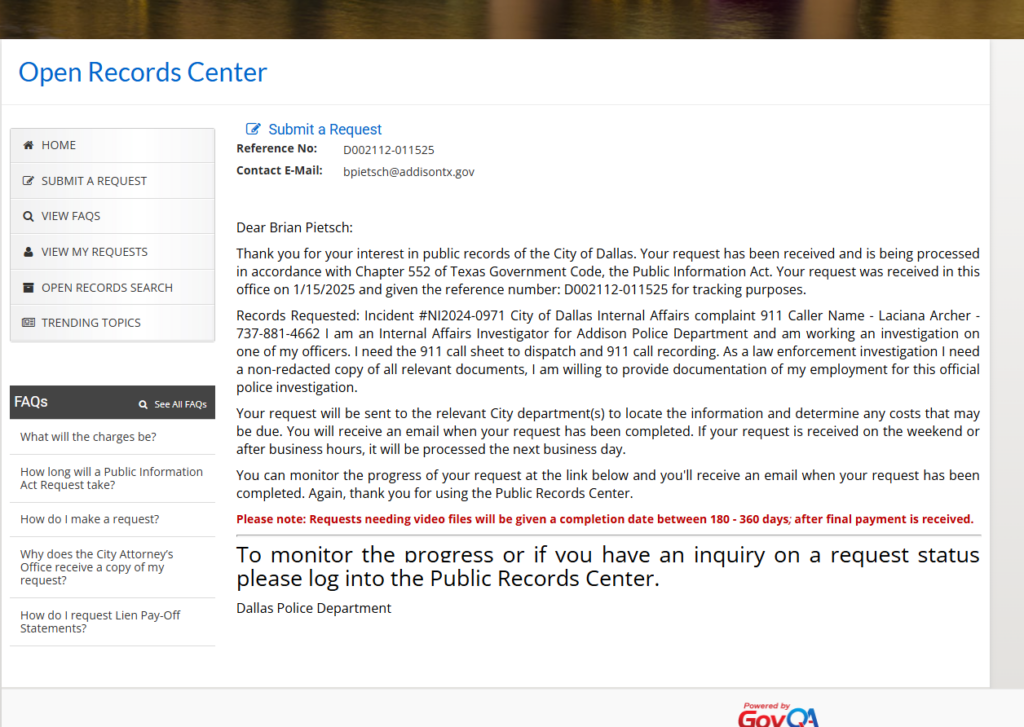
    “Under the Texas Public Information Act, I am requesting… all internal affairs or citizen complaints regarding Alan Schiek.” W013125-022026

    In 2023, you brought your cat to the department and left it unattended in the Records division.

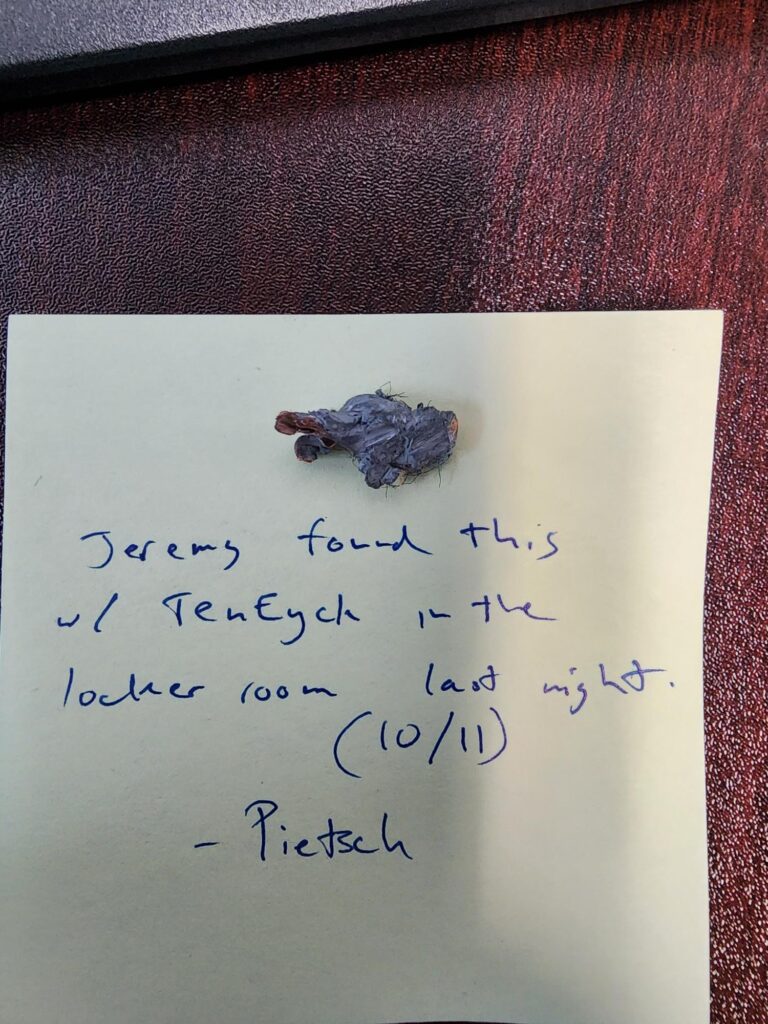
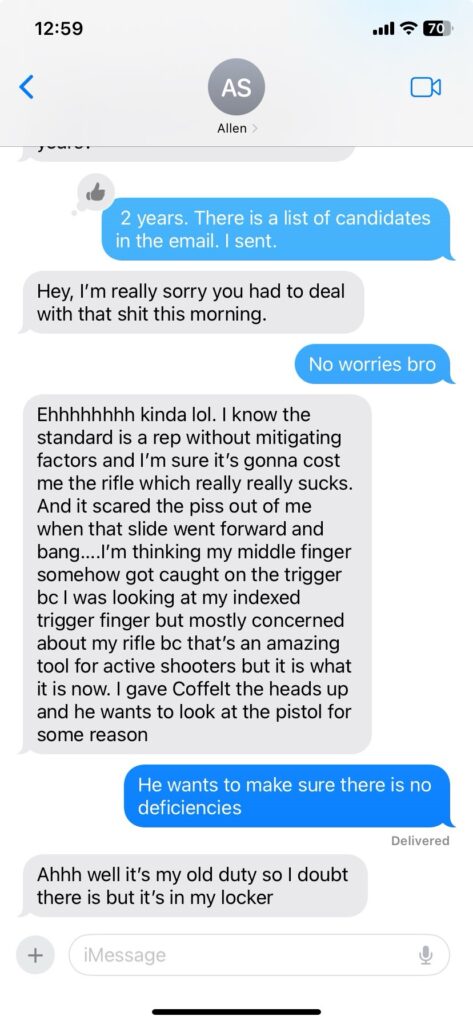
    In 2023, you negligently discharged your weapon while in the locker room. 

    During an off-duty encounter, you displayed concerning behavior, which has led to my loss of confidence in your ability to represent the Addison Police Department.

    The “Iron Circle” of Texas

    Alan Sheick’s off duty behavior, the road rage and stalking, led this woman to call the police and tell them “I am afraid for my life.

    Listen as the Police describe Road Rage, Stalking, Harassment, and dozens of other crimes by their Officer as “not that big of a deal.” “Something anyone would do…”

The Giza Audit and the Origins of Humanity